
Facts and information about blood cancer
Blood cancer is the UK’s third biggest cancer killer, yet awareness and understanding of it is much lower than for other types of cancer.
What is blood cancer?
Blood cancer is a type of cancer that affects your blood cells, and includes leukaemia, lymphoma, myeloma, myelodysplastic syndromes (MDS) and myeloproliferative neoplasms (MPN), including essential thrombocythaemia (ET), polycythaemia vera (PV) and myelofibrosis.
Blood cancer is what happens when something goes wrong with the DNA in your blood cells. These blood cells become abnormal, and multiply. These abnormal cells do not work properly, and so your blood is less able to carry out its role in keeping your body healthy, such as by fighting off infections or helping to repair your body.
Find more information on this in our what is blood cancer section.
How common is blood cancer?
Blood cancer is the fifth most common cancer in the UK, with over 40,000 people being diagnosed with it every year.(1)
Blood cancer is the Uk's third biggest cancer killer, and every year more than 15,000 people die of it.(2)
There are more than 310,000 people living with blood cancer in the UK.(3) One in every 19 people in the UK will develop it at some point in their lives.(4)
Blood cancer is the most common type of cancer amongst children, teenagers and young adults in the UK. Every year, more than 680 children aged under 15 and around 630 teenagers and young adults aged between 15 and 24 are diagnosed with blood cancer.
Leukaemia is the most common blood cancer type among children, while lymphoma is more common among teenagers and young adults.(5)
The risk of blood cancer goes up as you get older, and around 40% of people diagnosed with it are aged 75 or over.(6)
If you've just been told you have blood cancer
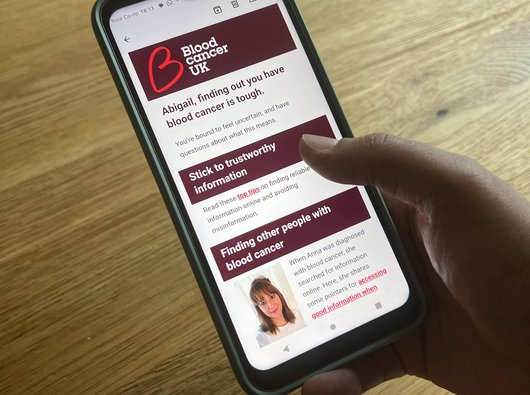
Sign up to our weekly support email for people recently diagnosed.
It gives you clear and simple information, practical tips and advice from others with blood cancer, to help during the first few weeks and months after diagnosis.
Different types of blood cancer
There are more than 100 different types of blood cancer. Most of these are types of leukaemia, lymphoma and myeloma, but the term “blood cancer” also includes other conditions such as myelodysplastic syndromes (MDS) and myeloproliferative neoplasms (MPN).
Some are fast growing (these types of blood cancer are called “acute”), while others grow more slowly (chronic). Sometimes the type of blood cancer can change as cancer develops. For example, MDS can turn into acute myeloid leukaemia (AML).
The five most common types of blood cancer in the UK are:
- Large B-cell lymphoma (affects more than 5,400 people a year)
- Chronic lymphocytic leukaemia, or CLL (affects more than 4,700 people a year)
- Myeloma (affects nearly 4,700 people a year)
- Essential thrombocythaemia (affects more than 2,700 people a year)
- Acute myeloid leukaemia, or AML (affects around 2,700 people a year)
These figures are estimates for the UK population based on detailed blood cancer incidence from one region of England.(7)
There is more information about the different types of blood cancer in our understanding blood cancer section.Acute myeloid leukaemia (AML)
Survival for different types of blood cancer
Different blood cancer types have very different survival rates.
Research breakthroughs over the last few decades mean that the five-year survival rates for some blood cancer types, such as chronic myeloid leukaemia (CML), chronic lymphocytic leukaemia (CLL) and follicular lymphoma are over 80%.(8)
However, survival is lower for other blood cancer types, such as mantle cell lymphoma, where five-year survival is 57%, and acute myeloid leukaemia (AML), where five-year survival is 22%.(8)
It's important to understand that these are averages, based on what has happened to a large group of people, who all survive for different lengths of time. The nature of how these figures are calculated also means that they relate to people diagnosed in England several years ago (2014-2016).
An individual person’s chance of a good outcome will depend on lots of factors. Even two people with the same condition can have quite different outcomes. So try to listen to what your clinician tells you about your prognosis, rather than worrying too much about overall survival rates for your type of blood cancer.
How has blood cancer survival changed over time?
We have come a huge way since Blood Cancer UK was founded in 1960. Back then, just one in 10 children diagnosed with leukaemia survived for at least five years.(9) Today, nearly nine in 10 children diagnosed with leukaemia in the UK survive for at least five years.(10)
Improvements in survival have also been seen for adults diagnosed with blood cancer.(11) And this progress has continued, with new treatments being developed every year. Recent data has also shown that blood cancer death rates in the UK have fallen over the past decade.(12)
You can find out more about the impact of the more than £500 million we’ve invested in research since 1960 on our research impact page.
But there is still a long way to go before we get to the point where everyone with blood cancer survives. Find out how you can fundraise to help us get there.
Diagnosis and treatment for people with blood cancer
Every year, the NHS gives world class treatment to many thousands of people with blood cancer. But there are still areas where the NHS could be doing better:
- In England and Northern Ireland, almost 30% of people with blood cancer are diagnosed through presenting to hospital as an emergency.(13) Although some of these emergency diagnoses would have been difficult to diagnose beforehand, others may be missed opportunities to diagnose earlier.
- 62% of people with blood cancer in England only see their GP once or twice before being diagnosed. This compares to 93% for breast cancer, and 81% for prostate cancer.(14) This is a serious issue because delayed diagnosis can lead to fewer treatment options, reduced quality of life and potentially reduced life expectancy.
- When they are diagnosed, just 69% of people with blood cancer in England completely understand what is wrong with them. This is lower than for breast cancer (81%); prostate cancer (79%); or lung cancer (77%).(14) This is why we produce health information to help people understand their type of blood cancer.
- Just 38% of people with blood cancer in England are spoken to about taking part in cancer research. That’s about the same as for lung cancer, and higher than for breast and prostate cancer. However, we think it's too low, with a further 30% of people with blood cancer saying that they weren’t spoken to about research but would like to have been. Taking part in a clinical trial can mean getting access to a promising new treatment not yet available on the NHS. You can talk to us and get information about any suitable trials by using our clinical trials service.
A big part of our work involves campaigning for improvements to healthcare for people with blood cancer. Find out how you can support our campaigns.
Why have these figures changed?
This page represents an update to a similar page previously published in 2022. Since then, sources and methodology have been updated which mean that some of these figures differ from those previously published. These figures represent the latest data available as of February 2026 and will be regularly reviewed and updated going forward.
You can find more key facts about blood cancer in our full Key Facts booklet. The booklet also includes sources and explanations for each figure.
Last full review March 2026. Next full review March 2027. We may make factual updates to the information between reviews.
References
(1) England: NHS England. Cancer Registration Statistics, England, 2023. https://digital.nhs.uk/data-and-information/ publications/statistical/cancer-registration-statistics/ england-2023. (2025)
Northern Ireland: Northern Ireland Cancer Registry. Cancer Data By Tumour Site. https://www.qub.ac.uk/research centres/nicr/cancer-information/cancer-data-by-tumour-type/. (2025)
Scotland: Public Health Scotland. Cancer incidence in Scotland. https://publichealthscotland.scot/publications/ cancer-incidence-in-scotland/cancer-incidence-in-scotland to-december-2023/. (2025)
Wales: Public Health Wales. Cancer incidence in Wales. https://phw.nhs.wales/services-and-teams/welsh-cancer intelligence-and-surveillance-unit-wcisu/cancer-reporting tool-official-statistics/cancer-incidence/. (2025)
(2) England: NHS England. Cancer Registration Statistics, England, 2023. https://digital.nhs.uk/data-and-information/ publications/statistical/cancer-registration-statistics/ england-2023. (2025)
Northern Ireland: Northern Ireland Cancer Registry. Cancer Data By Tumour Site. https://www.qub.ac.uk/research centres/nicr/cancer-information/cancer-data-by-tumour-type/. (2025)
Scotland: Public Health Scotland. Cancer mortality – Annual update to 2024. https://publichealthscotland.scot/ publications/cancer-mortality/cancer-mortality-in-scotland annual-update-to-2024/. (2026)
Wales: Public Health Wales. Cancer mortality in Wales https:// phw.nhs.wales/services-and-teams/welsh-cancer-intelligence and-surveillance-unit-wcisu/cancer-reporting-tool-official statistics/cancer-mortality/. (2025)
(3) England: National Disease Registration Service. England Cancer Prevalence Statistics, 2022. https://nhsd-ndrs. shinyapps.io/prevalence/. (2025)
Northern Ireland, Scotland and Wales: Freedom of Information requests received December 2025 and January 2026.
(4) Haematological Malignancy Research Network. Updated analysis, similar analysis accessible at: https://hmrn.org/ findings/lifetime_risk. (2026)
(5) National Disease Registration Service. Children, teenagers and young adults UK cancer statistics report 2021. https:// digital.nhs.uk/ndrs/data/data-outputs/cancer-publications and-tools/ctya-uk-cancer-statistics-report-2021. (2021)
(6) NHS England. Cancer Registration Statistics, England, 2023. https://digital.nhs.uk/data-and-information/ publications/statistical/cancer-registration-statistics/ england-2023. (2025)
Haematological Malignancy Research Network. Incidence by age group. https://hmrn.org/statistics/incidence. (2026)
(7) Haematological Malignancy Research Network. Incidence by diagnosis. https://hmrn.org/statistics/incidence. (2026)
(8) National Disease Registration Service. Detailed Statistics from the Get Data Out programme. https://digital.nhs.uk/ndrs/ data/data-outputs/cancer-data-hub/get-data-out. (2025)
(9) Dattani, S. Childhood leukemia: how a deadly cancer became treatable. Our World in Data. https://ourworldindata.org/childhood-leukemia-treatment-history. (2025)
(10) National Disease Registration Service. Children, teenagers and young adults UK cancer statistics report 2021. https:// digital.nhs.uk/ndrs/data/data-outputs/cancer-publications and-tools/ctya-uk-cancer-statistics-report-2021. (2021)
(11) Coleman, M. P. et al. Trends over 48 years in a one-number index of survival for all cancers combined, England and Wales (1971-2018): a population-based registry study. The Lancet Regional Health – Europe. (2025)
(12) Pinches, E. behind the headlines on falling cancer death rates and why research must keep going. Blood cancer UK. https://bloodcancer.org.uk/news/behind-the-headlines-on-falling-cancer-death-rates-and-why-research-must-keep-going/. (2026)
(13) England: National Disease Registration Service. Detailed Statistics from the Get Data Out programme. https://digital. nhs.uk/ndrs/data/data-outputs/cancer-data-hub/get-data-out. (2025)
Northern Ireland: Northern Ireland Cancer Registry. Routes to diagnosis of cancer. https://www.qub.ac.uk/research-centres/ nicr/cancer-information/routes-to-cancer-diagnosis/. (2025)
(14) NHS England. National Cancer Patient Experience Survey. https://www.ncpes.co.uk/latest-national-results/. (2025)